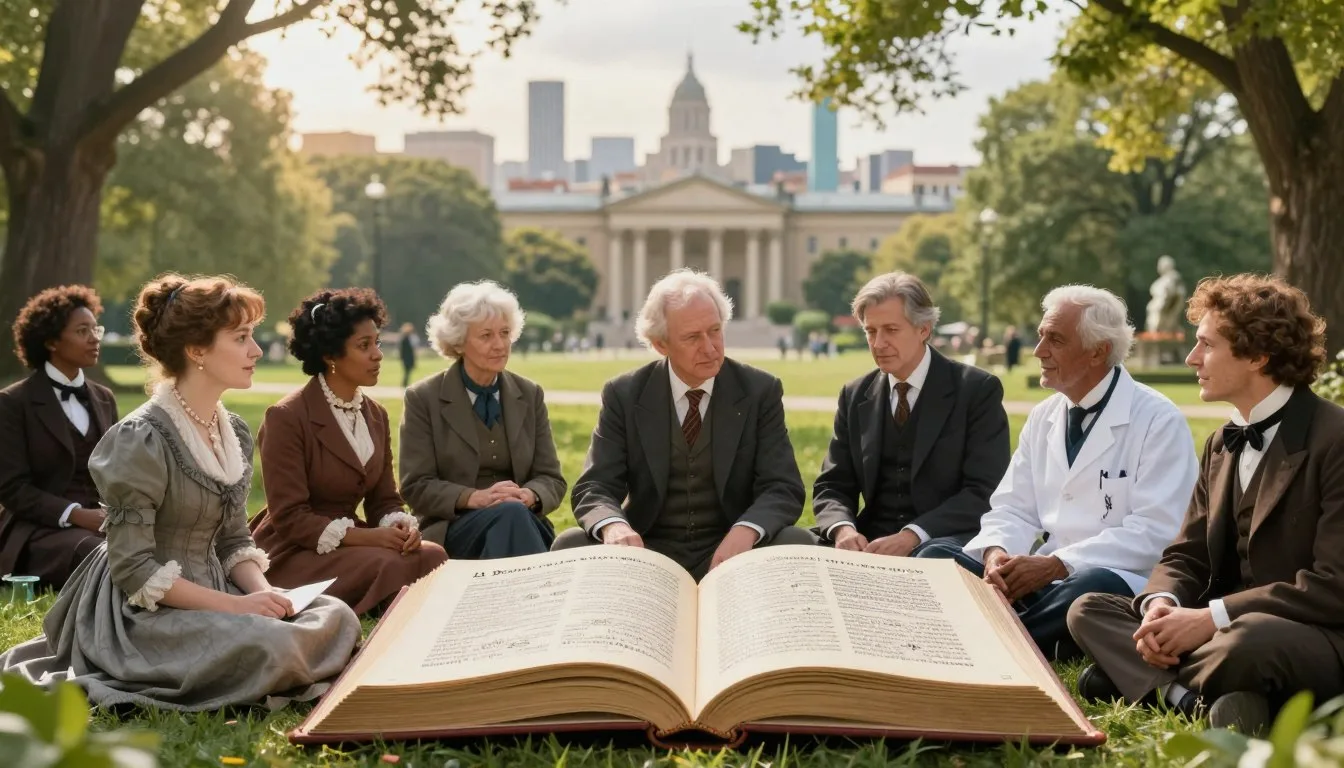
People who changed the world include figures whose ideas, discoveries, or campaigns altered institutions and everyday life. Their influence reaches across history, from science and civil rights to independence, politics, philosophy, and culture.
This selective list spans several fields rather than naming one definitive greatest person. Each person’s story shows a different route to influence, shaped by the needs and limits of a particular time.
Some legacies began with a new idea; others grew through years of organizing or work with collaborators. A lasting legacy can be measured in changed laws, shared knowledge, or opportunities opened for others.
How Do We Judge the Influence of People Who Changed the World?
A useful way to judge historical influence is to ask how far a person’s actions changed institutions, ideas, or later events. Influence describes effects, not a person’s moral worth.
A ranking’s value depends on the measure it uses. Michael H. Hart’s book The 100: A Ranking of the Most Influential Persons in History judges how much people changed history, not how good they were.
Hart’s influence-based ranking
Hart’s 1992 edition ranked Muhammad first, followed by Isaac Newton, Jesus, Siddhartha Gautama, and Confucius. Those names reflect Hart’s chosen test of influence, not a shared judgment about virtue.
| Rank | Person | Field | Why the figure is influential |
|---|---|---|---|
| 1 | Muhammad | Religion | Founder of Islam and a major religious and political leader |
| 2 | Isaac Newton | Science | Work shaped physics and mathematics |
| 3 | Jesus | Religion | Central figure of Christianity |
| 4 | Siddhartha Gautama | Religion | Founder of Buddhism |
| 5 | Confucius | Philosophy | Ideas shaped East Asian culture |
The 1992 edition included only two women. Hart partly explained that count by noting that women had often been denied opportunities to exert wide influence.
Why influence is not the same as greatness
Historical figures can shape events through different routes, so a top ten list works best as a cross-field shortlist. This one includes Muhammad, Newton, Jesus, Gautama, Confucius, Curie, King, Gandhi, Mandela, and Shakespeare.
Three questions help assess whether someone’s legacy lasted:
- Did the person change institutions?
- Did the person reshape widely held ideas?
- Did the person leave a legacy that continued after their lifetime?
Hart’s top five are one published ranking, not a moral verdict.
Readers asking who is the most important person in history of all time will find different answers under different measures. These people changed the world in varied ways, but no single list can settle every meaning of importance.
Read any ranking by its stated measure, since a measure of influence does not establish moral greatness.
How Did Marie Curie Change Science?
Marie Curie’s impact joined discoveries in radioactivity to new roles for women in science. Her work earned recognition in two different fields, while her career also opened doors in research and teaching.
Curie was the first woman to win a Nobel Prize and the first person to win two. She remains the only person to win Nobel Prizes in two different scientific fields.
Two Nobel Prizes in different fields
In 1903, Curie shared the Nobel Prize in Physics with Pierre Curie. They received it for joint research on radiation phenomena discovered by Henri Becquerel.
The 1911 Nobel Prize in Chemistry recognized a distinct body of work. Curie discovered radium and polonium, isolated radium, and studied its nature and compounds.
Marie and Pierre Curie named polonium after her native Poland. Their research helped establish radioactivity as a field of study and gave other scientists a basis for further work.
Research put to practical use
Curie became the first woman professor at the University of Paris in 1906. That milestone challenged limits on women’s careers, but scientific skill is not tied to one gender.
During the First World War, she developed mobile radiography units for field hospitals. The units brought X-ray services closer to injured soldiers, where doctors could use them to examine wounds.
Her institutional work continued after the war. Curie founded the Curie Institute in Paris in 1920 and a second institute in Warsaw in 1932.
Her mobile radiography work shows how scientific knowledge can become a practical tool in a crisis.
How Did Martin Luther King Jr. Advance Civil Rights?
King’s civil rights leadership combined nonviolent protest with the ability to bring a mass audience together. His public advocacy drew attention to racism and demands for equal rights.
The 1963 March on Washington brought 250,000 demonstrators to the Lincoln Memorial. King delivered his “I Have a Dream” speech there, as one speaker in a larger collective action.
A mass demonstration in Washington
The march brought people together to call for civil and economic rights. King’s speech became closely linked with the event, but one speech did not create the civil rights movement.
Organizers, local groups, and many other activists had built the movement over time. Their work included public demonstrations and campaigns against segregation and discrimination.
Nonviolent protest and international recognition
Civil disobedience is the deliberate refusal to obey a law or rule as a form of nonviolent protest. King used nonviolent action to challenge racism and press for civil rights.
In 1964, King received the Nobel Peace Prize for his nonviolent campaign against racism and his struggle for the civil rights of the Afro-American population. The award recognized a campaign carried by many people, not only its best-known leader.
The 1963 march joined individual advocacy to a demonstration involving 250,000 people.
How Did Gandhi Help India Win Independence?
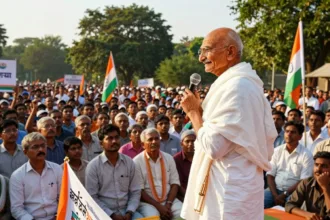
India’s independence followed decades of organizing, with Gandhi and the Indian National Congress using nonviolence and civil disobedience in the 1920s. Their campaigns formed part of a long movement against British colonial rule.
The Indian National Congress began in 1885 with demands for greater rights and access to the Civil Service. Early leaders sought economic rights for Indians and the chance to sit British Indian Civil Service exams.
From early political demands to mass movements
The Indian independence movement ran from the mid-1880s to 1947. By the 1920s, Gandhi and the Indian National Congress led mass efforts using nonviolence and civil disobedience.
Several major campaigns marked the movement’s growth:
- Non-cooperation Movement, 1919-1922
- Civil Disobedience Movement, 1929-1931
- Quit India Movement, begun in 1942
These campaigns encouraged people to resist colonial rule through organized action. The effort involved many leaders and participants over several decades.
Independence and partition in 1947
The Indian Independence Act 1947 ended Crown suzerainty in British India. It also partitioned the territory into the Dominion of India and the Dominion of Pakistan.
India and Pakistan became independent at midnight on August 14-15, 1947. The legal change and partition were political outcomes of a broad movement, not the achievement of one person alone.
The 1947 settlement brought independence alongside the partition of British India.
How Did Nelson Mandela Help End Apartheid?
Mandela’s political work began long before his release from prison, starting with his entry into the African National Congress in 1944. He helped challenge apartheid through organizing, legal work, and later political leadership.
South Africa’s first all-race democratic elections took place in 1994. Mandela became president after the African National Congress won, following years of protest and political change.
Organizing, trial, and imprisonment
Mandela and Oliver Tambo opened South Africa’s first Black law firm in 1952. Their work gave Black clients access to legal help under an unequal system.
Authorities arrested Mandela in 1956 and charged him with treason alongside 155 others. The trial lasted four-and-a-half years, and the defendants were acquitted.
After police killed 69 protesters at Sharpeville in March 1960, the government declared a state of emergency and banned the African National Congress. Mandela received a life sentence in 1964 and went to Robben Island.
Key dates trace his path from political work to democratic change:
- 1944: Mandela joined the African National Congress.
- 1952: He and Tambo established their law firm.
- 1964: He received a life sentence.
- February 11, 1990: He was released after 27 years in prison.
- 1994: South Africans of all races voted in democratic elections for the first time.
Release and democratic transition
Mandela was released on February 11, 1990, after 27 years in prison. His release came as the country moved toward negotiations and a new political system.
In 1993, Mandela and South African President F. W. de Klerk shared the Nobel Peace Prize for their efforts to bring stability to South Africa. Their award reflected work toward a transition, not the end of every challenge.
Mandela stepped down as African National Congress president in 1997. Thabo Mbeki led the party to victory in the 1999 elections.
The 1994 election marked a change in who could vote, not just a change in who held the presidency.
Which Women Changed Civil Rights and Education?
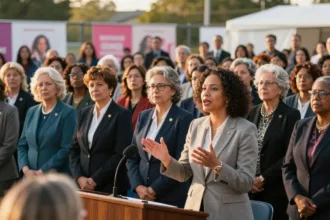
Women have changed history through very different forms of action, from public protest to education advocacy and wartime rescue. Rosa Parks, Malala Yousafzai, and Irena Sendler each worked in a distinct setting.
Their legacies show three different routes to impact: collective protest, education advocacy, and rescue under occupation. Their risks and aims were not the same.
Rosa Parks and collective action
On December 1, 1955, Parks refused to give up her bus seat in Montgomery. Her arrest was followed by the Montgomery Bus Boycott, a community campaign against bus segregation.
Parks’s action gained broad force through collective protest. Women also played vital roles in civil rights organizing, education, and voting-rights work across the movement.
The National Park Service describes women’s roles in the movement, including Black women’s civil rights organizing. Ella Baker, Septima Clark, Dorothy Height, and Fannie Lou Hamer each contributed through leadership and community work.
Malala Yousafzai and education rights
Malala Yousafzai became a public advocate for girls’ education. Her work drew attention to the right of girls to attend school and take part in public life.
She also founded the Malala Fund, which supports girls’ education advocacy. At 17, she became the youngest Nobel Peace Prize recipient.
Irena Sendler and wartime rescue
During Nazi occupation, Irena Sendler helped rescue an estimated 3,000 Jewish children. Her work involved grave risks under a regime that persecuted Jewish people.
Authorities arrested and tortured Sendler in 1943. She refused to disclose information about the children and those who helped them.
Keep the distinct setting of each woman’s work in view when comparing their legacies.
Which Scientists and Inventors Changed Everyday Life?
Tools and scientific discoveries can change everyday life when later generations find ways to use them widely. Their reach depends on both an original idea and the systems that spread it.
An invention’s impact depends on later adoption as well as the first breakthrough. Printing, medicine, and power show how discoveries can alter daily routines and future research.
Tools that spread knowledge
Johannes Gutenberg’s movable-type printing press dates to around 1440. It helped make the broader circulation of texts possible, changing how people could share written knowledge.
Printing did not spread by itself. Printers, readers, and later systems of publication helped turn the tool into a lasting part of communication.
Discoveries that reshaped science and medicine
These figures changed knowledge or practical work in different ways:
| Figure | Contribution | Field | Lasting change |
|---|---|---|---|
| Johannes Gutenberg | Movable-type printing press | Printing and communication | Broader circulation of texts |
| Isaac Newton | Classical mechanics and calculus | Physics and mathematics | Foundations for later science and engineering |
| Alexander Fleming | Discovered penicillin in 1928 | Medicine | Major advance in treating bacterial infections |
| Michael Faraday | Work that helped make electricity a viable power source | Science and technology | Practical use of electricity |
| Charles Darwin | Evolution and natural selection | Biology | New account of how species adapt |
Newton laid foundations for classical mechanics and co-invented calculus. Faraday’s work helped make electricity a viable power source, while Darwin changed scientific thinking about how species adapt.
Fleming’s 1928 discovery of penicillin became a major advance in treating bacterial infections. Its later medical use depended on work beyond the original discovery.
Separate the original discovery from the systems and work that turn it into common practice.
Which Political Leaders Reshaped Their Countries?
Political influence can take different forms, as Lincoln, Napoleon, and Washington show. Their historical reach came through war, law, and the creation of a new government.
Power and influence do not automatically make someone the greatest or best person. A leader’s effect on a country is one question; moral judgment is another.
Lincoln and the U.S. Civil War
Abraham Lincoln served as U.S. president from 1861 to 1865, during the Civil War. The Emancipation Proclamation took effect on January 1, 1863, making emancipation a central part of the war’s political legacy.
Napoleon and the remaking of French law
Napoleon Bonaparte reshaped French law through a post-revolutionary code. It set out laws on property, families, and individual rights.
Washington and the new republic
George Washington led American forces to victory in the Revolution and became the first president of the United States. His influence came through military leadership and the new presidency.
| Leader | Country | Main lever | Political legacy |
|---|---|---|---|
| Abraham Lincoln | United States | Civil War leadership and Emancipation Proclamation | Emancipation during the war |
| Napoleon Bonaparte | France | Post-revolutionary legal code | Laws on property, families, and individual rights |
| George Washington | United States | Revolutionary War leadership and first presidency | Leadership in the founding of the republic |
People asking who was the greatest person in the world may weigh leadership, law, or moral conduct differently. History’s best person in the world is not a fixed title that political power can settle.
Judge a leader’s historical reach separately from whether you consider that leader admirable.
How Did Religious and Philosophical Ideas Shape Society?
Some of history’s most enduring influence has traveled through religious traditions and philosophical teachings. Their lasting reach comes from ideas that communities carried forward over time.
Religious traditions and philosophical systems are distinct, even when each shapes public life. Their influence can be studied through history without ranking the truth of their beliefs.
Faith traditions with lasting reach
Jesus was a first-century Jewish preacher and is the central figure of Christianity. Christianity has more than 2 billion followers, making its tradition a major force in world history.
Siddhartha Gautama, known as the Buddha, founded Buddhism. The teachings associated with Jesus and the Buddha belong to different faith traditions, each with its own history and practice.
Ethics and government in East Asia
Confucius developed ethical and political ideas that shaped East Asian culture. His philosophy addressed conduct and society, rather than founding a religion like those associated with Jesus and the Buddha.
Teachings can persist through study, practice, and institutions that pass them to later generations. Their reach also changes as communities interpret them in new settings.
Compare the reach of an idea through its historical effects, not by collapsing distinct traditions into one.
How Did Artists and Writers Change Culture?
Art and literature can change culture by giving people new ways to represent conflict, identity, and possibility. Creative work can shape a shared public imagination without inventions or political office.
Cultural influence can come from the work itself, not only from its creator’s fame. Shakespeare, Picasso, and Leonardo da Vinci show different ways art can travel across time.
Shakespeare and the written word
William Shakespeare lived from 1564 to 1616 and became one of history’s best-known playwrights. His plays gave audiences vivid characters and conflicts that later writers and performers continued to explore.
Picasso and modern art
Pablo Picasso painted Guernica in 1937 as an anti-war work. The painting turned the suffering of war into a lasting visual statement.
Leonardo da Vinci across disciplines
Leonardo da Vinci lived from 1452 to 1519 and worked as an artist, scientist, and inventor. His varied interests show how creative work can cross the lines between fields.
Consider the continuing reach of the work itself, not only the fame of its creator.
How Is Influence Recognized Today?
Contemporary honors lists group influential figures by the kinds of contributions they make. TIME’s 2026 TIME100 uses categories such as Icons, Artists, Pioneers, and Titans to organize its honorees.
A present-day honors list and a historical ranking answer different questions. One groups current honorees; the other tries to judge how deeply a person shaped events over time.
A category can point to the kind of work a person does, but it does not measure lasting impact by itself. A figure’s influence may take years to become clear, especially when institutions or later generations carry the work forward.
Current recognition also reflects the present moment. A historical view asks how ideas and actions affected people beyond that moment.
Treat a category as a starting point for understanding a person’s work, not as a verdict on historical importance.
Look at the person’s work and its effects beyond the label attached to an honor.
Conclusion
The clearest takeaway is that history changes through both individual choices and collective effort. A leader may shape events, while collaborators and communities help carry that work forward.
Historical reach is different from moral approval. A person can change laws, ideas, or institutions without becoming a model for every choice they made.
Choose one figure from the list and trace the people and institutions that carried their work forward.