Students are best prepared for the future when they can think critically, communicate clearly, work with others, manage themselves, and use information responsibly. These abilities support classroom learning, college readiness, future careers, and everyday challenges. No single skill guarantees success; students benefit from a mix of practical and transferable abilities.
That mix matters in a changing world, where students meet new tools, demands, and choices at every age. They can build these abilities from childhood through adulthood, using each stage of life to practice in new ways. Some skills help with a school assignment today, while others help with work or daily decisions later.
Students do not need to master every ability at once. They need chances to learn, try, and improve skills in settings that matter to them. A useful skill is one students can practice in class and apply beyond it.
What Are the Essential Skills for Students?
Essential skills for students combine personal and social competencies with abilities that transfer across subjects, stages of life, and workplaces. Together, they help students understand themselves, relate to others, and respond to new tasks. A useful core set includes self-awareness, communication, reasoning, collaboration, and self-management.
Explicit teaching and practice help make skills learnable. SAFE instruction means sequenced, active, focused, and explicit teaching that gives students structured practice in a skill.
Skills grow through clear teaching, repeated practice, and chances to use them in real situations.
Skills for understanding yourself and others
CASEL names five connected social-emotional learning (SEL) competencies: self-awareness, self-management, social awareness, relationship skills, and responsible decision-making. They help students notice emotions, manage reactions, understand other people, and build relationships.
CASEL says students can learn and use these competencies from childhood through adulthood. Relationship skills, for example, help a student share an idea, listen to a classmate, and work through a difference.
Skills that transfer across school and work
The World Health Organization’s 1996 life-skills categories include ten abilities, from empathy and creative thinking to coping with stress and emotions. The categories also cover decision-making, problem-solving, communication, and relationships.
Tony Wagner’s seven competencies include critical thinking, collaboration, adaptability, initiative, communication, information analysis, curiosity, and imagination. These frameworks show why education needs skills that reach beyond one subject.
There is no fixed list that fits every age or goal. A younger student may practice asking for help, while a college student may use the same skill during a demanding course. A skill becomes more transferable when students practice using it in more than one setting.
Which Thinking Skills Help Students Solve New Problems?
Students solve unfamiliar problems more effectively when they can question information, assess evidence, and test possible solutions. Critical thinking helps them judge claims, while analytical reasoning helps them compare facts and spot patterns. Information literacy means finding, evaluating, organizing, and using information effectively.
Strong problem-solving joins careful reasoning with creative thinking. Students can use these connected abilities to ask better questions, weigh explanations, and build solutions when a familiar answer does not work.
These five abilities give students a practical way to approach a new challenge:
- Ask focused questions about the problem.
- Check the evidence behind a claim.
- Identify assumptions that may shape a conclusion.
- Compare possible explanations before choosing one.
- Test a solution and examine what happens.
Computer skills now matter because students meet information through digital tools. In 2023, U.S. eighth-graders averaged 482 in computer and information literacy, above the international average of 476.
The U.S. average fell from 519 in 2018. One-quarter of U.S. eighth-graders did not reach the lowest proficiency level in 2023, while 3% reached the highest level.
Computational thinking, or using computing ideas to solve problems, also presents a challenge. U.S. eighth-graders averaged 461 in 2023, below the international average of 483 and down from 498 in 2018.
In computational thinking, 27% scored at Level 1, compared with 24% across participating education systems. Another 15% scored below Level 1, compared with 10% across those systems.
These test results describe performance on specific tasks, not every part of a student’s ability. Before accepting a claim, students should be able to identify what evidence supports it and what remains uncertain.
How Can Students Build Digital and Media Literacy?
Digital literacy means knowing how to protect personal information, communicate responsibly, and judge what appears on a screen. Responsible participation in online spaces, or digital citizenship, also includes respect for others and healthy habits. Students build these skills through lessons and guided practice.
Students need both safety habits and sound ways to judge online content. These skills apply to social media, school research, games, chats, and other digital spaces.
Use digital tools safely and thoughtfully
Students can learn to set privacy controls, create strong passwords, and recognize phishing, which is an attempt to trick people into sharing information. Safe chats, digital identity, media balance, and respectful communication also need practice.
In 2023, 78% of U.S. eighth-graders said they learned to manage account privacy settings outside school. Across participating education systems, 59% said the same.
Common Sense Education’s third-grade lessons cover passwords, digital identity, kindness, cyberbullying responses, and checking altered images or videos. Its sixth-grade lessons add media balance, phishing, safe chats, credible news, and ways to ease digital conflict.
Check media and online information
Students can check who made a post, when it appeared, and whether other reliable reports support its claims. Comparing accounts and looking for signs of altered images or video can reveal missing context.
A 2022 poll cited in a 2024 review found that 91% of U.S. respondents saw misinformation as a significant problem. Social media use is widespread: up to 95% of youth ages 13-17 use a platform.
More than a third of those youth say they use social media almost constantly. Nearly 40% of children ages 8-12 use social media, although platforms commonly set 13 as the minimum age in the United States.
Social media can support connection, self-expression, information, and support. It can also pose risks to mental health and well-being, though its effects are not the same for every student.
Students can respond to cyberbullying or online conflict by avoiding hostile replies and seeking help from a trusted adult. Students should pause before sharing a startling post and check its evidence, source, and original context.
Which Personal Skills Help Students Manage Time and Independence?
Students manage demanding schedules more reliably when they break large responsibilities into smaller tasks and give each a place in their calendar. Self-management helps students keep track of schoolwork, personal duties, and rest. It also supports independence as responsibilities grow.
A realistic plan includes both work and time to recover. Practical independence also involves daily tasks that academic study techniques do not teach on their own.
Plan time, tasks, and goals
Students can begin by listing deadlines, then deciding which tasks matter most. A large assignment becomes easier to start when divided into steps, such as choosing a topic, gathering information, drafting, and revising.
A calendar can hold due dates, practice sessions, and appointments in one place. Students should set goals they can reach and leave room for sleep, meals, and breaks.
For college students, a weekly plan can include class time, study blocks, work shifts, and personal needs. The goal is not to fill every open hour, but to make important tasks visible.
Build practical and financial independence
Independent living can involve budgeting, meal planning, laundry, appointments, safe technology use, and transportation. These life skills help students handle ordinary needs as they take on more responsibility.
A practical checklist groups 100 skills into nine areas, including home care, personal care, financial responsibility, academic success, and time management. Other areas include professional skills, transportation, life management, and problem-solving and conflict resolution.
Financial literacy helps students compare costs, plan spending, and make informed choices without relying on promises about a particular product. Digital, financial, and AI literacy are emerging literacies for future-ready students.
A short weekly review can help a student notice an overloaded schedule before deadlines pile up.
How Do Communication, Collaboration, and Leadership Work in Practice?
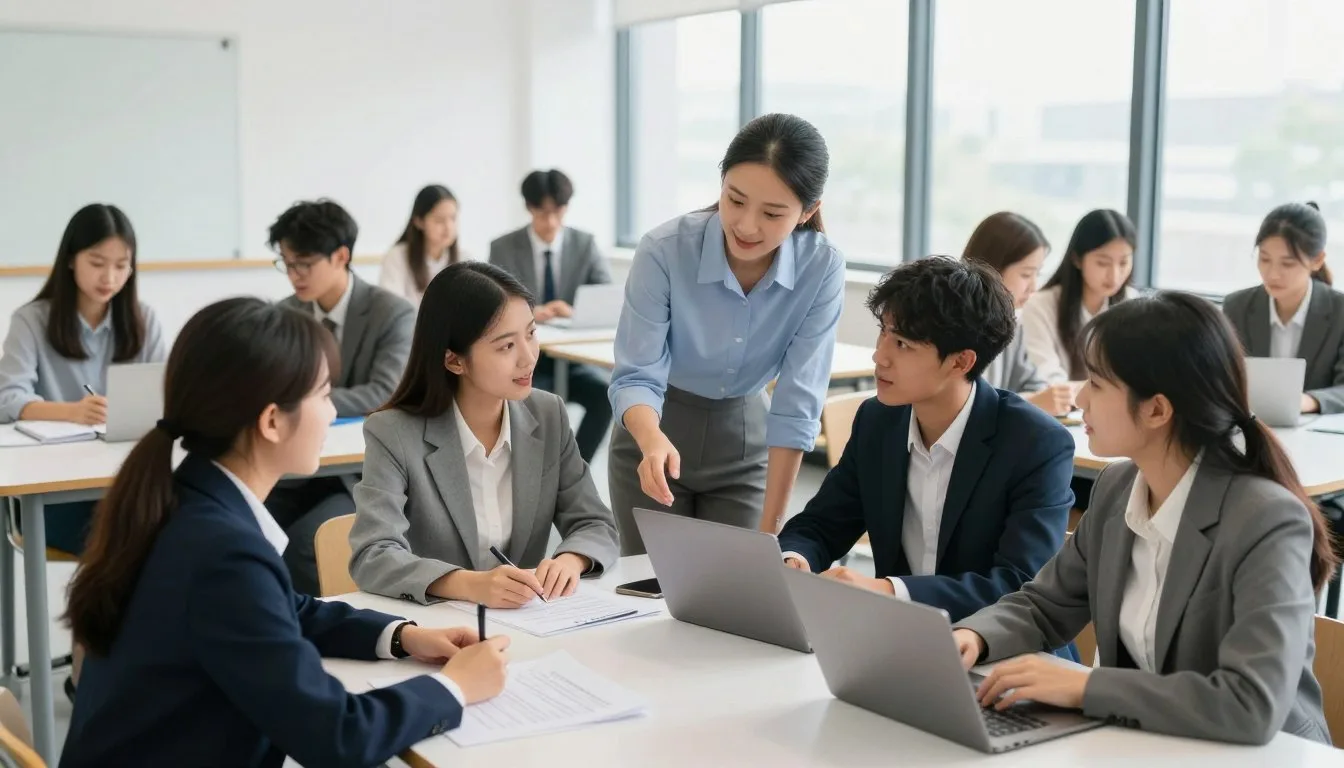
Communication and collaboration become visible when students listen, explain an idea, and help a group reach a shared decision. Clear communication includes speaking, writing, and presenting ideas in ways others can follow. It also depends on listening with care.
Good teamwork joins respectful exchange with shared responsibility. Students can build these abilities through everyday group tasks, not only through formal leadership roles.
A student may listen during a group task, explain a plan, or give a short presentation to the class. Empathy helps students consider how an idea may affect others.
Respectful disagreement focuses on the idea rather than the person. Students can ask for reasons, explain their own view, and adjust a plan when another point makes sense.
These habits matter beyond school. NACE’s Career Readiness Competencies include communication, critical thinking, teamwork, and professionalism.
Take initiative and contribute to a team
Leadership can mean taking responsibility for one part of a project, helping a group settle on a plan, or asking what needs doing. Reliability means following through on an agreed role.
When a group faces a problem, students can name the issue and help find a fair solution. Taking initiative does not mean doing everything; it means contributing toward a shared goal.
The Kentucky Graduate Profile Academy names communication, critical thinking, quantitative reasoning, adaptability, leadership, and teamwork among ten competencies. Its profile also includes working across diverse backgrounds, civic engagement, professionalism, applied learning, and using information for decisions.
Nearly 90% of employers seek evidence of problem-solving when evaluating candidates. These employer frameworks show why such skills matter at work, but no single skill guarantees a job.
In a group project, make each student’s responsibility clear so that teamwork includes accountability as well as participation.
How Can Students Practice and Show These Skills?
Students can show what they have learned by pairing a specific skill with a real example of using it. Concrete evidence makes growth easier to discuss than a general claim. Projects, presentations, research tasks, peer feedback, and service learning give students chances to practice.
Assessment can include critical thinking, collaboration, and communication. AASA’s Public Education Promise names these as life skills that school districts can include in student assessments.
A clear example shows what a student did, what changed, and what the student learned.
Students can make learning visible in four ways:
- Save a project or other work sample.
- Note the role the student took.
- Reflect on a challenge and the response.
- Describe the result in specific terms.
About half of employers in 2023 considered graduates very prepared to show critical skills. Fewer than half felt graduates were highly prepared in communication.
In the same year, 91% of surveyed students said better employment opportunities were an important or very important reason for attending college. After a project, have each student record one contribution and one next step for improvement.
Conclusion
Students build future readiness through repeated practice, not by mastering every skill at once. A broad mix of life skills can help them learn, handle responsibilities, and take part in new opportunities.
One useful starting point is a skill that matters in a student’s current routine. Practicing it in a real task can show what works and what needs attention.
That small effort can make future challenges easier to approach. Choose one upcoming task and decide which skill to practice deliberately.