
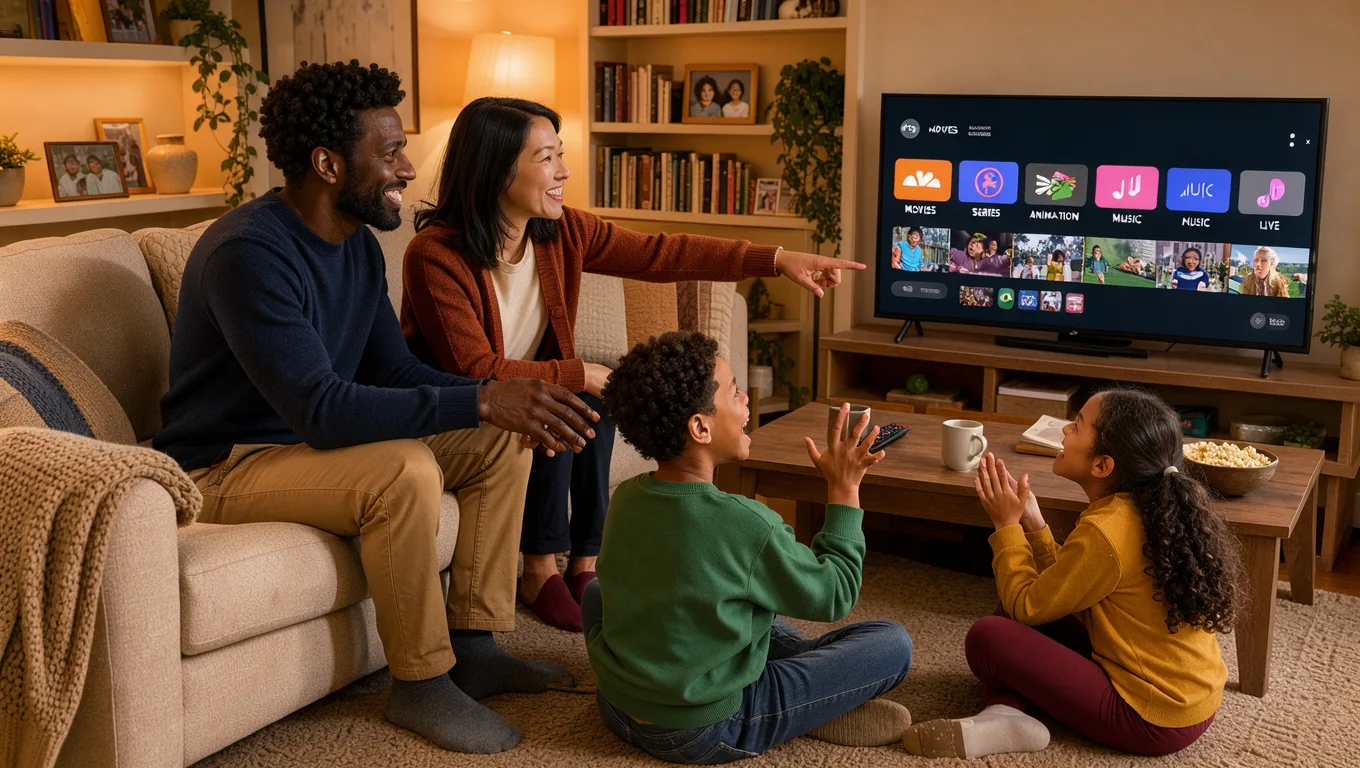
Streaming has given viewers more ways to choose what to watch, when to watch, and whether to pay a subscription or watch ads. Streaming platforms suit people who want more control over entertainment, but the right mix depends on your viewing habits and household budget.
You may be balancing new movies, favorite shows, sports, and several monthly bills. Paid on-demand apps offer libraries, free ad-supported services offer shows and channels, and live-TV services replace some cable packages.
No single service carries every title and channel. The best starting point is a short list of the shows, movies, or live events you actually watch.
How Does Internet Video Reach Your Screen?
A streaming video starts playing from an internet connection before the full program has arrived on your device. This on-the-fly delivery lets you choose video without waiting for the whole file to download.
Over-the-top (OTT) means video or other media delivered over the public internet instead of through cable, satellite, or broadcast distribution. OTT video bypasses traditional TV distribution routes, then travels through your internet connection to an app or browser.
Streaming needs an internet connection and compatible hardware or software, and playback can suffer when the connection is unreliable.
You can watch on smart TVs, computers, phones, and streaming devices. Each service needs compatible software, and a program may not be available on every screen.
Some services let you download selected titles, while others provide access only through playback in an app. Buying a digital title does not always give you a permanent file; access terms differ.
Before subscribing, check that the service’s app works on the screen you plan to use.
How Have Online Viewing Habits Changed?
Nearly seven in ten U.S. households used a FAST service during the second half of 2025. Free ad-supported streaming television, or FAST, has become a common option alongside paid subscriptions.
FAST use grew across both household reach and viewing time: monthly active U.S. households were up 12% year over year as of August 2025. Average daily FAST viewing hours per household rose 16% year over year in 2025.
Those numbers do not mean every household watches the same way. Some use free channels every day, while others turn to them when a paid library lacks a desired show.
U.S. FAST household use shows that free viewing is more than a marginal choice. More viewing time may reflect the appeal of a channel-like option that does not add a subscription bill.
A FAST service can sit beside an on-demand streaming service, rather than replacing every paid library. Paid plans may offer particular originals or titles that free catalogs do not carry.
Treat free viewing as a genuine part of the household mix, not just a backup for occasional use.
Which Streaming Platforms Fit Your Viewing Habits?
The right fit is usually the service type that matches your most frequent viewing, not the one with the longest list of titles. Start with your routine: movies and series, free viewing, or scheduled channels.
Paid on-demand services suit library-focused viewers, FAST suits people who want free access, and live-TV services suit channel watchers. A narrow interest may not call for a broad bundle.
On-demand libraries for series and movies
An on-demand subscription service, or SVOD service, gives you a catalog to browse and play when you choose. Netflix, Disney Plus, HBO Max, Hulu, Prime Video, and Apple TV are familiar examples.
These streaming services compete through different mixes of movies, series, and original shows. No one service has every title, and catalogs can change over time.
If you follow a few ongoing shows, a paid library may be easier than searching across many apps. Check whether your must-watch series are included before choosing a plan.
Free viewing supported by ads
Free ad-supported on-demand viewing lets you watch selected movies and shows without a subscription. Tubi and Pluto TV are useful starting points when no monthly fee matters more than uninterrupted playback.
Ad breaks support the service, and each catalog has its own selection. A free app can fill quiet evenings without replacing a paid library you use for specific originals.
Live-TV packages for scheduled channels
YouTube TV and Sling TV are live-TV services for viewers who want scheduled channels. They may fit a household that regularly watches news, sports, or network programs as they air.
A viewer who mainly follows one niche genre may not need a broad bundle of channels. Write down the three programs or events you watch most before comparing individual plans.
What Do Popular On-Demand Plans Cost?
Among major U.S. on-demand apps, entry plans in October 2026 ranged from $9 to $15 a month. That starting price may include ads or limit access to certain features.
Compare the exact plan, not just the service name, because each service may offer several paid levels. The prices below give a snapshot of major U.S. options, not every niche or regional service.
Starting prices for major on-demand services
In October 2026, Netflix started at $9 a month, Disney Plus at $12, and HBO Max at $11. Hulu started at $12.50, while Prime Video with ads and Paramount Plus with ads each started at $9.
Apple TV started at $15 a month. These entry plans do not all offer the same viewing experience, and some include ads.
In 2026, Peacock Select cost $9 a month, Peacock Premium cost $13, and Peacock Premium Plus cost $20. The names mark three distinct plan choices.
Hulu’s ad-supported plan cost $12.50 a month in 2026, compared with $20.50 for its ad-free plan. That gap may matter if you watch often and dislike interruptions.
Paramount Plus with Showtime cost $14 a month in 2026, while its basic ad-supported plan cost $9. The higher tier includes a different mix of features and content.
A complete price list should name the exact tier and billing period, not only the service. A bundle can also change the total, so count only the parts you would use.
For people looking for a list of all streaming services and prices, no short snapshot can cover every regional or niche option. Compare the exact tier you would use, since the entry price may include ads or omit premium features.
How Do Ads Change the Price and Experience?
For many viewers, ads are an acceptable trade for a lower monthly bill, but a substantial minority strongly dislikes them. Your own tolerance matters more than a general average.
In December 2025, 68% of viewers said they would rather save money by watching ads than pay more to avoid them. One in eight said they could not tolerate ads during TV shows and movies.
An ad-supported plan makes sense only if the savings feel worth the interruptions. If ads spoil your viewing, compare the ad-free upgrade before you commit.
Ads also play a growing role in the business. Streaming drew $17.2 billion in upfront advertising dollars in 2026, compared with $16.6 billion for linear TV.
Ads are projected to provide nearly 28% of streaming services’ revenue by 2028. That shift does not mean every service or plan will use the same ad load.
Prime Video’s default plan included ads in 2026, and removing them cost an extra $5 a month. That fee is one service’s example, not a standard charge across the market.
Check whether live events and every title in a plan remain ad-free before paying extra.
When Is Live TV Worth Paying For?
A live-TV package is worth considering when you regularly watch scheduled channels, especially news, network shows, or sports. Live viewing matters when you want a program as it airs.
A live-TV package brings scheduled channels together, while an on-demand library lets you pick from available titles. Pay for live channels when you use them often enough to justify the higher bill.
Hulu Plus Live TV cost $100 a month in 2026, a concrete budget check for households weighing a cable replacement. On-demand apps and free options may suit viewers who do not need scheduled channels.
Sports access can depend on a paid level, even when you already use another service. Peacock Premium is required to watch live sports such as Sunday Night Football on Peacock.
That does not mean every sports fan needs a full live-TV package. A household following only one event or league should check whether that programming is available without one.
Also consider how often the household watches live news or network shows. A package used for one game each month may not fit the same budget as one used daily.
Confirm that the channels and events you actually watch are available in your area before signing up.
Which Live TV Service Replaces Cable Best?
For a broad cable-like lineup and DVR, YouTube TV is the clearest starting point; Sling TV Blue wins on the listed monthly price when its narrower lineup works. Your channel needs decide which tradeoff fits.
YouTube TV cost $83 a month in 2026, compared with $46 for Sling TV Blue. Local stations and sports can change how useful either plan feels in your home.
YouTube TV for broad channel access
YouTube TV is a strong choice when you want many channels and room to record programs. It includes unlimited cloud DVR storage and up to three simultaneous streams.
It was the first live-TV streaming service to include local PBS stations. YouTube TV may suit a household that wants a broad channel mix without managing a cable box.
Sling TV for a narrower package
Sling TV Blue offers a lower listed monthly price, though its lineup is narrower. It included ABC, NBC, and Fox local channels only in a few cities in 2026.
That limited local access can matter if you rely on a nearby network affiliate. Compare the channels you actually watch, not only the plan name.
Philo for entertainment-focused channels
Philo cost $25 a month in 2026, or $33 with its premium bundle. It includes entertainment channels such as AMC, Comedy Central, Nickelodeon, and Magnolia Network.
Philo also includes unlimited cloud DVR, but it is not a broad sports-and-local lineup. Its fit is stronger when entertainment channels matter more than live sports.
Before choosing, compare this short checklist:
- Channel lineup
- Local network affiliates
- DVR storage and recording rules
- Simultaneous streams
- Premium add-ons
Check the exact local-channel lineup by ZIP code before treating any live-TV package as a complete cable replacement.
Where Can You Watch Free Movies and Shows?
Tubi and Pluto TV are useful first stops when you want to watch without a monthly subscription. Free access usually means ad breaks, not an all-access promise.
No app provides every movie or every channel for free, and each catalog changes. Choose between a title library and a channel grid based on how you want to watch.
Free on-demand catalogs
Tubi and The Roku Channel offer free catalogs of movies and shows. You can browse and pick a title instead of waiting for a scheduled program.
These services use ads to support viewing. A specific movie may not be available when you look, even if the app has many other titles.
Channel-grid FAST apps
Pluto TV, Xumo Play, Sling Freestream, and Local Now offer channel-style viewing without a paid live-TV plan. Their grids make it easy to turn on a channel and watch whatever is playing.
Use this short list to choose a starting point:
- For on-demand catalogs: Tubi and The Roku Channel
- For a channel grid: Pluto TV, Xumo Play, Sling Freestream, and Local Now
Free services can be a good fit for familiar shows or a casual movie night, but their lineups differ. Check the title’s availability in the app before planning a movie night around it.
How Does Free Ad-Supported TV Work?
FAST means free ad-supported streaming television, a mix of channel-style programming and on-demand viewing funded by ads. It blends two habits: browsing a channel guide and choosing a title.
FAST does not work like a paid library alone, because it can combine linear channels, on-demand programs, and live broadcasts. Ads help cover the cost of free access.
FAST services run by media companies
Media companies run FAST services that offer scheduled channels and catalogs of programs. Some let you watch a show from a library, while others recreate the feel of turning on a TV channel.
Major FAST platforms had 1,455 linear channels in June 2022 and 1,943 by May 2024. That growth shows how much wider the channel choices became.
For viewers looking for new streaming platforms, Xumo Play, Sling Freestream, and Local Now are additional FAST options. These services are not necessarily new; they are further choices in the free market.
FAST channels built into television devices
Some smart-TV makers place free channels inside the television interface. Samsung TV Plus, LG Channels, Vizio WatchFree+, Sony’s Live TV on PS5, and TCL Channel are examples.
These services can make free channels easy to find without adding a separate paid plan. The channels and apps vary by device maker.
Use the channel guide when you want scheduled viewing and the on-demand library when you want to choose a specific title.
Which Live Platforms Suit Creators and Viewers?
YouTube led the tracked live-streaming platforms in watch time in the 30 days ending November 2, 2026. For a broad start, YouTube Live combines large viewership with ways to find completed broadcasts.
Tracked platforms recorded 31.7 billion hours watched in Q3 2026. YouTube had 4.68 billion hours in the 30-day period, compared with 1.52 billion for Twitch and 732.24 million for Kick.
Live platform watch-time totals show how audiences can differ by platform. Watch time alone does not guarantee that a new creator will find viewers.
YouTube Live and replay discovery
Completed YouTube Live broadcasts remain as channel videos. Search and recommendations can help those replays reach viewers after a broadcast ends.
The lower YouTube Partner Program tier requires 500 subscribers, three valid public uploads in 90 days, and either 3,000 valid public watch hours in 12 months or three million valid public Shorts views in 90 days.
Ad-revenue eligibility has a higher bar: 1,000 subscribers and either 4,000 valid public watch hours in 12 months or 10 million valid public Shorts views in 90 days.
Twitch, Kick, and BIGO LIVE monetization
Twitch offers subscriptions, Bits, and eligible ad revenue as creator income sources. Kick offers creators a 95% share of eligible subscription revenue.
BIGO LIVE supports guest rooms, PK battles, audio-only broadcasts, and virtual gifts converted into Beans. Its interactive tools may suit creators who want more direct audience participation.
These platforms like Twitch differ in features and community style. Here are ten options to compare:
- YouTube Live
- Twitch
- Kick
- BIGO LIVE
- TikTok LIVE
- Instagram Live
- Facebook Live
- LinkedIn Live
- Vimeo
- DLive
Choosing a first platform as a new streamer
Compare audience fit, moderation tools, replay discovery, and the rules for earning. A smaller platform may fit your topic better than the one with the most total watch time.
Before building a channel, verify the current monetization rules for the platform and format you plan to use.
Where Can You Find Newly Available Movies and Shows?
A release date on a streaming service is tied to an individual title, so check the exact movie or show before subscribing. Availability changes by title, and one service’s new arrivals may not match another’s.
Confirm the title and service together before adding a paid plan. Release calendars can help you spot dates, but they do not mean every film is available to every viewer.
Track new streaming releases
Rotten Tomatoes listed The Cycle as streaming October 23, 2026, and Verity for October 27. The Invite was listed for August 11, while Obsession was listed for June 30.
Resident Evil and Sense and Sensibility were listed for November 3, 2026. Tenzing was listed for October 16, and The Weight for October 20.
Primetime was listed for November 3, 2026, while Collision Course was listed for October 30. These dates show why a title’s own release listing matters.
Streaming release dates for these titles can help narrow a search, though availability may differ by region.
Search across services before subscribing
JustWatch can search across services, offer recommendations, and keep one watchlist across services and devices. It is a discovery tool, not a guarantee that every title is available in every region.
Search for a specific movie or series before adding another recurring bill. Confirm the service and date shown for the title you want before paying for another month.
Which Service Fits Movies, Series, or Sports?
Start with the programs you watch most often, because a service’s fit depends on its catalog and your viewing routine. Specific titles matter more than a claim about the biggest library.
On-demand services are a practical starting point for movies and series; regular live sports call for a live-TV service. Your viewing calendar can help separate those needs.
Choose by the content you watch most
Sort your usual viewing into movies, serialized shows, reality programming, and niche interests. One broad library may not suit every person in a household.
Reality programming accounted for nearly 11% of aggregate FAST viewing time in 2025. That share shows reality shows have a place in free viewing, though it does not mean every service has the same titles.
Netflix, Hulu, Apple TV, Disney Plus, Peacock, and YouTube TV serve different on-demand or live-TV needs. Streaming platforms for movies should be compared by the specific titles available, not a promise of the largest library.
Match the service to the viewing occasion
An ordinary movie night gives you time to browse and choose an available film. A live game is appointment viewing, so you need the right channel or event access at the scheduled time.
Consider whether you watch a sport every week or only follow a major event now and then. The same plan can feel useful during a busy season and unnecessary later.
Check the next month’s viewing calendar before adding a sports-focused plan.
What Should You Check Before Subscribing?
Before paying, check that the plan includes the title, picture quality, and device features you expect to use. Small plan details can change what you see and hear.
Confirm title access, device support, and plan limits before you start paying. A service’s best quality features depend on the plan and compatible equipment.
4K describes picture resolution, while HDR can show a wider range of brightness and color. Dolby Vision is a format for HDR video, and Dolby Atmos is an audio format.
Apple TV streams all its original titles in 4K, HDR, Dolby Vision, and Dolby Atmos, and it does not show ads. That is one service’s offering, not a standard for all streaming apps.
Check whether the plan allows enough simultaneous viewing for your household. Also confirm download access and whether the plan includes ads.
Some titles may not use every picture or audio feature. Make sure your TV, sound system, and internet setup support the features you are paying for.
How Can You Reduce Monthly Streaming Costs?
A simple monthly review can reveal subscriptions that continue billing after you stop watching. Small checks can help keep entertainment spending aligned with your household budget.
Cancel or pause plans that no longer serve a clear purpose. NerdWallet users who used its subscriptions and bills feature averaged 12 subscriptions and recurring bills, including streaming services.
Try these steps when you review your recurring charges:
- Review your credit card and bank statements.
- Cancel services you did not use this month.
- Rotate nonessential on-demand subscriptions.
- Compare bundle costs with the services you actually watch.
- Use free ad-supported viewing where it fits your routine.
A bundle is not automatically cheaper if it includes services your household does not use. A plan that looks like a deal can still add to the bill without replacing a current need.
Keep a short note of the shows or events that justify each paid plan. That makes it easier to spot services you keep only out of habit.
Set a calendar reminder to review recurring charges before each renewal cycle.
What Limits Should You Expect From Streaming?
Streaming’s convenience depends on having a working connection and a screen that supports the service’s app. Those basics affect whether you can start a program when you want.
Internet access and compatible hardware or software are needed for streaming playback. Netflix, YouTube, and Apple TV are examples of services used across internet-connected screens.
Catalogs can change as licensing deals shift, so a title available today is not a permanent promise. The same service may also offer different apps or features on different devices.
Use this quick check when planning for limits:
- Confirm the screen supports the app.
- Expect the catalog to change over time.
- Check whether the specific title allows downloads.
- Save downloads before you lose internet access.
A download can help when you lack a connection, but services do not make every title available offline.
Check download access for the specific titles you want if you expect to watch away from home.
Conclusion
A useful streaming lineup is the smallest combination of services that covers what you genuinely watch. Your viewing habits and total monthly budget matter more than the number of apps you can add.
Free ad-supported viewing can complement paid services when its catalog or channels fit your routine. Write down your must-watch titles and events, check where they are available, and subscribe only to the plan that fills a real gap.