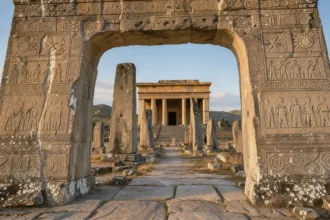

Ancient societies still shape modern life through ideas and systems that people use, adapt and encounter every day. Their influence appears in laws, calendars, city plans, languages and cultural traditions. A cradle of civilization is a region where an early civilization first emerged.
People often meet these legacies without knowing their age. A familiar way to divide an hour, a public building or a written rule may have roots thousands of years old. Yet modern society is not a direct copy of any ancient one. Each generation has changed older ideas to meet new needs.
Independently developed societies left different kinds of legacies across Africa, Asia, Europe and the Americas. Some built large cities, while others created ways to record information or organize public works. Their influence is easiest to see by tracing specific ideas back to the places and people that developed them.
What Defines a Civilization?
A civilization is a complex society with organized government, social differences, urban life and shared ways to record or express information. Archaeologists use these features to describe how people organized life in large communities. There is no single test that fits every society.
Common markers include a state, social classes, cities and symbolic communication beyond spoken or signed language. The broad list also includes monumental buildings, distinctive art, shared communication, territorial rule and divided work. Food surpluses helped support people who did not farm full time.
Many accounts recognize six cradles of civilization: Mesopotamia, Egypt, India, China, Caral-Supe and the Olmec region. A useful definition of civilization also notes that scholars debate which features matter most. These regions developed in different settings and did not follow one shared path.
- State organization with leaders or public institutions
- Social hierarchy, including differences in rank or wealth
- Urban centers where many people lived close together
- Symbolic communication, such as writing or signs
- Food surplus that could support non-farming work
- Specialized work, from building to craft production
- Territorial administration across a defined area
The table names broad regions, not one unified culture in each place. The Americas row includes two distinct centers, Caral-Supe and the Olmec.
| Region | Cradle | Geographic setting |
|---|---|---|
| Mesopotamia | Sumerian and later states | Tigris-Euphrates basin |
| Egypt | Ancient Egypt | Nile Valley |
| India | Indus civilization | Indus River region |
| China | Early Chinese states | Yellow River region |
| Americas | Caral-Supe and Olmec | Coastal Peru and Mexico |
These features describe patterns, not a test every society must pass.
Criteria help scholars compare complex societies, but they cannot capture every part of a culture. Treat the features as a useful framework, not a claim that every society developed in the same order.
Where Do Ancient Civilizations Appear on a Timeline?
The earliest civilizations took shape between 4000 and 3000 B.C.E., but no single start date settles which civilization was first. Farming and trade helped support food surpluses and steadier economies. Those changes allowed some settlements to grow into cities.
From farming villages to the first cities
Uruk, Ur, Kish and Eridu were among the earliest cities to reach populations of tens of thousands. Susa and Memphis followed by the 31st century B.C.E. A city’s growth did not always match the start of its society.
A civilization’s emergence, its first city, its writing system and its first dynasty can have different dates. The timeline offers approximate points rather than one exact starting line for all regions.
| Approximate period | Place or development | Why it matters |
|---|---|---|
| 4000-3000 B.C.E. | Early urbanization | Farming and trade supported larger settlements |
| By the 31st century B.C.E. | Early cities and states | Uruk, Ur, Kish, Eridu, Susa and Memphis grew |
| 1200-1150 B.C.E. | Late Bronze Age collapse | Major disruption affected southwestern Asia and the eastern Mediterranean |
| About 1050-753 B.C.E. | Phoenician alphabet, Greek city-states, Olympics and Rome | New political and writing traditions took shape |
Independent centers across the world
The Late Bronze Age collapse took place between 1200 and 1150 B.C.E. in southwestern Asia and the eastern Mediterranean. Later milestones include the Phoenician alphabet around 1050 B.C.E., the rise of Greek city-states around 800 B.C.E., and the first recorded ancient Olympic Games in 776 B.C.E. Rome’s traditional founding date is 753 B.C.E.
Searches for an ancient civilizations timeline, the oldest civilization in the world timeline, or a list of ancient civilizations often expect one simple ranking. Yet “top 10” and “top 20” oldest lists depend on how civilization is defined.
Twenty illustrative societies include Sumerian, Akkadian, Babylonian, Assyrian, Egyptian, Elamite, Indus, Shang, Zhou, Caral-Supe, Olmec, Zapotec, Maya, Chavín, Minoan, Mycenaean, Greek, Phoenician, Persian and Roman. This is not a definitive order.
Read any “oldest” ranking alongside its definition of a civilization and the evidence used to date it.
How Did Mesopotamia Change Recordkeeping?
In Mesopotamia, writing began as a practical tool for keeping track of goods, payments and rules. Sumerian writing developed around 3100 B.C.E. in a region between the Tigris and Euphrates rivers. Early cuneiform used wedge-shaped marks pressed into clay.
Some of the oldest written records dealt with ordinary tasks, not grand stories. They included taxes, grocery bills and laws about theft. As cities such as Uruk and Ur grew, officials needed records that could last beyond a spoken exchange.
Writing supported several basic needs:
- Tracking goods stored, sold or moved between people
- Recording obligations, including taxes and payments
- Preserving rules about theft and other disputes
Those tasks mattered in growing cities with many workers and goods. A spoken message could reach only the people present, and memory could fail. A clay record let officials check an account later or pass information to another administrator.
By the 31st century B.C.E., Uruk, Ur, Kish and Eridu had populations of tens of thousands. Their size made durable records useful for managing trade, agriculture and public duties. The written marks linked daily life with city government.
Remember that some of the earliest written records were ordinary accounts, not literary works.
What Did Ancient Egypt Leave Behind?
Along the Nile, ancient Egyptian rulers built a durable society whose monuments still make its political power visible. Egypt’s First Dynasty began around 3100 B.C.E., while the New Kingdom began around 1550 B.C.E. These were different eras in a long history of rule.
Pyramids and royal tombs show the ability to organize large building projects. The Nile supported farming and travel, while rulers directed labor toward temples and monuments. These structures made royal authority visible in stone.
A cubit was a measure of length roughly equal to the span of a forearm. Builders could use it to mark stone blocks or plan walls. A body-based unit gave workers a practical way to repeat measurements across a project.
Egypt’s royal history still changes as archaeologists study new finds. In 2025, a tomb discovered in the western wadis near the Valley of the Kings was reported to belong to Thutmose II. He ruled from 1493 to 1479 B.C.E.
The report connects a new discovery with a ruler from the New Kingdom period. It also shows how tombs preserve clues about Egypt’s kings and burial customs. The cubit shows how a simple, body-based measure could help make large building projects repeatable.
What Made the Indus Valley Civilization Distinctive?
Indus Valley cities stand out for the way streets, bricks and water systems were planned together. The mature Harappan phase of the Indus Valley civilization began around 2600 B.C.E. City planning joined several practical features into one urban design.
Harappa and Mohenjo-daro each held about 40,000 to 50,000 people. Both had baked-brick buildings, grid-patterned streets, and organized water and sewer systems. Drainage and water supply formed part of the city plan, not an afterthought.
Uniform bricks helped builders create walls and buildings with shared measures. Streets crossed in planned patterns, while drains carried wastewater away. Wells and other water systems helped people meet daily needs in dense settlements.
The Indus script remains undeciphered. Without readable texts, scholars cannot use the society’s own written accounts to explain its laws, leaders or daily routines. Archaeology still reveals how people built and used their cities.
A well-organized city does not, by itself, prove every detail about centralized rule. Archaeological remains show planning, but they cannot settle all questions about who made each decision. Keep the undeciphered script in view when distinguishing archaeological evidence from claims about daily life.
How Did Ancient China Build a Lasting State?
Shang inscriptions show that a developed Chinese writing system existed before later dynasties unified standards across an empire. The Shang dynasty began around 1600 B.C.E. Oracle-bone writing is clear evidence of written Chinese in that period.
Shang inscriptions appear on bones used in divination, a practice for seeking answers about the future. The earliest known Chinese characters come from Shang inscriptions dating back more than 3,000 years. Later state reforms were separate developments from the Shang writing evidence.
| Dynasty | Dates | State or writing development |
|---|---|---|
| Shang | From about 1600 B.C.E. | Oracle-bone inscriptions show developed writing |
| Qin | 221-206 B.C.E. | Standardized writing, currency and measurements |
| Han | 206 B.C.E.-220 C.E. | Institutionalized Confucian bureaucracy |
The Qin dynasty ruled from 221 to 206 B.C.E. and brought standards for writing, currency and measures under one Chinese empire. Shared standards helped officials work across distant parts of the state.
The Han dynasty followed, ruling from 206 B.C.E. to 220 C.E. It made Confucian bureaucracy part of government, giving officials a shared set of ideas and practices. These changes shaped later Chinese culture and administration.
Distinguish the Shang evidence for writing from the Qin and Han changes to administration.
What Does Caral-Supe Reveal About Early Peru?
Coastal Peru developed an early center of monumental architecture while other first cities were emerging across the world. Caral-Supe began around 3200 B.C.E. This early Andean center shows that large settlements and public building also arose in the Americas.
Caral-Supe included organized settlements and monumental structures built with stone and other local materials. Large public buildings point to shared labor and planned activity. They do not mean every community in the region lived in the same way.
Peru’s long history includes places that formed many centuries apart. Peñico, an ancient Peruvian city unveiled in July 2025, is 3,800 years old. The site contains 18 structures, including ceremonial temples and residential compounds.
Peñico’s 18 structures belong to that site, not to Caral-Supe as a whole. Its temples and homes offer a later view of settlement life in Peru. The two places help show a long regional history without making them one society.
The Inca Empire arose much later than Caral-Supe. Their records and political systems belong to a different period of Andean history. Keep Caral-Supe and the much later Inca Empire distinct when tracing the history of Peru.
What Did the Olmec and Later Mesoamerican Cultures Contribute?
Mesoamerica’s ancient cultures developed their own traditions of monumental art, writing and observations of the sky. The Olmec flourished in pre-Columbian Mexico from 1500 to 400 B.C.E. They were not the later Maya or Aztec societies.
Olmec communities created distinctive art and stone monuments. Later Maya cities developed sophisticated writing, mathematics, architecture and astronomy. Maya writing combined pictorial signs with phonetic characters that represented sounds.
Maya records of the sky linked observation with written knowledge. Across Mesoamerica, societies also developed distinctive calendars and fine arts. Calendar traditions helped communities mark time, though their systems did not all match.
Central America and Mexico held many different peoples, languages and political systems. A shared region did not mean one common script or government. The Maya, Olmec and Aztec belonged to distinct periods and traditions.
Monumental art can reveal public beliefs and the skill of craftspeople, while writing offers another kind of evidence. Researchers must connect each object or text to the society that made it. Treat Mesoamerica as a succession of related but distinct societies, not as one civilization.
Which Greek Ideas Still Shape Public Life?
Greek city-states helped make political participation, public performance and organized athletic competition enduring subjects of civic life. These independent cities rose around 800 B.C.E. Ancient Greece was not one unified empire.
Each city-state had its own government and customs. The first recorded ancient Olympic Games took place in 776 B.C.E. Athletes competed as part of a shared religious festival, linking sport with public life.
Greek traditions influenced later societies without making modern democracy identical to ancient Athenian democracy. Ancient Athens allowed some citizens to take part in decisions, but not everyone living there had that right.
Greek philosophy asked lasting questions about knowledge, justice and how people should live. Theater brought stories and debates before public audiences. Epic poetry carried tales about heroes, conflict and the gods across generations.
Political ideas from Greek city-states later shaped debates about government and citizenship. Modern systems have changed those ideas and extended political rights in ways ancient Athens did not. Treat ancient democracy as an influence on modern systems, not as their exact equivalent.
How Did Rome’s Legal and Linguistic Legacy Spread?
Rome’s legacy reached beyond its former territory through language and legal traditions. Its traditional founding date is 753 B.C.E., a convention rather than a securely documented start. Its influence spread through centuries of rule and later use.
Spanish, French, Portuguese, Romanian, Catalan and Italian developed from Latin. Each language changed over time, but shared roots remain visible in words and grammar. Latin also served as a language of learning and public records.
Roman law remained in use across Western Europe through the 18th century. Its concepts shaped legal study and government in many places. That long use does not mean every modern rule came directly from Rome.
Roman legal traditions changed as rulers and communities applied them to new conditions. Later laws also drew on other customs and ideas. The persistence of a legal tradition does not mean that modern law is unchanged from ancient Rome.
How Did Ancient Societies Turn Rules Into Law?
Writing laws down gave rulers and communities a more durable way to state rules than relying on oral memory alone. In Athens, Draco replaced oral law with written law in 621 B.C.E. A written rule could be seen and remembered beyond a spoken meeting.
Mesopotamia also linked writing and law through the Code of Hammurabi, associated with cuneiform. The code set out rules and penalties in a durable form. It belonged to its own society, not to a modern legal system.
Written rules can clarify what a government expects, but they cannot ensure fair enforcement. A record may make a rule easier to consult, yet officials still decide how to apply it. People may also face unequal treatment under the same code.
Draco’s laws and the Code of Hammurabi came from different societies and periods. Both show how writing could make rules more visible. Neither should be treated as a modern legal system with equal rights and shared protections.
A written code records rules, but it does not by itself guarantee equal treatment under them.
How Did Different Peoples Record Information?
Ancient societies recorded information in more than one way, and not every system used an alphabet or a page. Different tools served different needs, from writing sounds to counting goods. Their records show varied ways of organizing ideas.
The Phoenician alphabet emerged around 1050 B.C.E. It was an important part of alphabetic writing’s history, but it was not the origin of every writing system. Other societies developed forms of writing on their own.
Alphabets and written scripts
Maya writing combined pictorial signs with phonetic characters. Pictorial signs could convey ideas through images, while phonetic signs represented sounds. This distinct system helped Maya cities record information and preserve knowledge.
An alphabet, a pictorial and phonetic script, and a knotted record system work in different ways. Each can preserve information, but the marks and materials vary.
- An alphabet uses signs to represent sounds in spoken language.
- A pictorial and phonetic script combines image-based signs with signs for sounds.
- Knotted accounting records use cords, knots and colors to track information.
Records made without alphabetic writing
The Inca used a khipu, a recordkeeping device made from strings tied in patterned knots and colors. Khipu helped account for population and production across the Andes. Their knots and cords differed from written scripts, but still stored information.
Comparing these systems means looking at what each could record and how people used it. Alphabetic writing was one approach among many. Do not treat the absence of alphabetic writing as the absence of recordkeeping.
Which Ancient Building Systems Still Have Practical Lessons?
Roads and water systems made it possible for ancient cities and governments to connect people with essential services. Roman roads linked distant parts of the empire and helped military travel. Public works also moved goods and supported daily needs.
Roads and long-distance movement
Roads let Roman officials, soldiers and travelers move between places. They also helped carry messages and goods across Roman territory. A connected route could support government in areas far from a central city.
Road networks helped move people and goods across long distances. Their military use mattered too, since troops could travel between regions. Ancient roads did not offer the speed or access of modern transport.
Water systems and urban services
Roman aqueducts brought freshwater to towns, helping improve sanitation and hygiene. In the Indus Valley, cities had organized drainage, sewage and water supply systems. These systems addressed different needs through planned public works.
Ancient water services depended on local design and conditions. Aqueducts carried water toward towns, while drains and sewers helped manage waste. Neither system worked like a modern network with treatment plants and household pipes.
Three basic needs shaped these projects:
- Moving people and goods across a region
- Bringing freshwater into towns and cities
- Managing waste in crowded settlements
Comparing infrastructure by its purpose makes its limits clear. A road could ease travel, while a water channel could help supply a town. Judge an ancient system by the problem it solved, not by whether it matches a modern network.
What Can Trade and Large Cities Tell Us About Lesser-Known Civilizations?
Trade routes and city remains can reveal the connections and scale of societies that receive less attention in familiar histories. Great Zimbabwe’s trade network reached from the Maghreb along Africa’s eastern coast, and as far as India and China. Its reach crossed regions.
Trading networks that crossed regions
Great Zimbabwe was built between 1100 and 1450 C.E. More than 10,000 people lived there at its peak. Its trading links show that African societies took part in long-distance exchange across land and sea routes.
Trade connected places with different goods, customs and political ties. The route’s broad reach points to links between African regions and partners far beyond them. It does not mean every community had the same role.
Cities and evidence from the Americas and Africa
Teotihuacan had as many as 200,000 residents between 300 and 600 C.E. That estimate applies to a specific period, not the city’s entire history. Its size shows the scale of urban life in ancient Mexico.
Five life-sized busts found near Mérida, Spain, in May 2023 are thought to be the only known depictions of the Tartessos people. The busts date to the 5th century B.C.E. They offer a rare form of evidence about a people known through limited remains.
| Society or evidence | Date or period | What it reveals |
|---|---|---|
| Great Zimbabwe | 1100-1450 C.E. | More than 10,000 residents at peak and wide trade links |
| Teotihuacan | 300-600 C.E. | As many as 200,000 residents |
| Tartessos busts near Mérida | Found in May 2023; busts date to 5th century B.C.E. | Rare depictions of the Tartessos people |
A striking artifact can improve the evidence for a culture without answering every question about it.
Which Ancient Ideas Can You Still See in Daily Life?
Ancient ideas remain visible in familiar measurements of time and in the calendars people use to organize daily life. Mesopotamian base-60 mathematics underlies the 60-second minute, 60-minute hour and 360-degree circle. Those divisions still shape clocks and maps.
Ancient Egyptian timekeeping included a 24-hour day and a 365-day calendar. These systems helped people organize time in ways that remain familiar today. Everyday measures can carry old ideas into modern routines.
Books offer different regional depth, rather than one universal ranking of societies. These titles provide starting points for readers interested in separate places and periods:
- The Ancient Near East: A Very Short Introduction by Amanda H. Podany
- Ancient Egypt: A Very Short Introduction by Ian Shaw
- The Indus Civilization: A Contemporary Perspective by Gregory L. Possehl
- The Oxford History of Ancient Egypt, edited by Ian Shaw
- The Ancient Greeks by Robin Osborne
Choose a book by region, since no single ranking can explain every society equally well.
A focused account can show how one society changed over time. A second book from another region can reveal different choices and paths. Choose a book by the region you want to understand first, then compare its account with another society.
Conclusion
Ancient influence is not a single inheritance but a collection of ideas and systems that later societies reshaped. Their effects can be direct or indirect, and people have changed them to fit new needs. The present is not a copy of the past.
A calendar, legal idea or city system offers a concrete place to begin. Choose one familiar practice and ask where it developed, who used it and how it changed. Pick one familiar system and trace its history to see how many different societies helped shape the present.