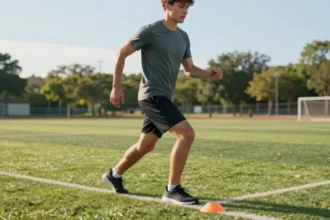

Professional athletes stay fit and mentally strong by pairing goal-specific training with consistent fueling, recovery, and mental-health support. You can adapt these ideas to recreational activity without copying a professional’s training volume.
Progressive overload means gradually increasing a training demand as your capacity improves. That might mean adding a little weight, choosing a harder movement, or doing more work over time.
Schedules change with each sport, season, and person. A long training day may suit one athlete, while another needs shorter sessions around work, school, or family.
The aim is not to fill every day with exercise. It is to give training, food, rest, and mental health a steady place in your routine.
This article offers practical ways to shape those habits around your goals and available time. A coach or health professional can help tailor them when your needs are more complex.
A useful routine is one you can sustain while meeting the demands of your sport and daily life.
How Athletes Stay Fit Across a Season
A reliable training baseline is to work every major muscle group at least twice a week, then adapt the schedule to sport practice and competition. A steady plan helps athletes build fitness without letting each workout compete with games or skill practice.
The 2026 ACSM position stand reviewed 137 systematic reviews covering more than 30,000 participants. Its guidance notes that home-based routines, bands, and bodyweight exercises can improve strength, muscle size, and physical function.
Volleyball player Bergen Reilly’s team lifts about four times per week in season. Her training includes squats, hang cleans, box jumps, and wall squats, alongside the demands of team practice.
Choose a plan that fits your sport, experience, and access to equipment. A useful routine is one you can repeat with sound form.
Simple options include:
- Bodyweight exercises, such as squats and pushups
- Resistance bands for pulls and presses
- Machines for guided strength work
- Free weights for varied movements
Progressive overload gives you a way to keep improving: raise one training demand gradually as your capacity grows. Adjust the workload when practice or competition leaves less time or energy.
Training to failure, complex periodization, and choosing machines over free weights did not consistently change results for average healthy adults. A useful Fit Facts check is whether advice names its goal and audience instead of promising one routine for everyone.
Apply the same care to ACE Fit Facts: notice whether advice separates a general starting point from individual programming. Choose an option you can repeat with good technique and gradually make more challenging.
Which Strength Workouts Match Your Goal?
The best resistance-training setup depends on whether your priority is lifting heavier, building muscle, or producing force quickly. Your goal shapes the load, number of sets, and pace of each repetition.
Choose loads for strength or power
For strength, use a heavier load: about 80% of your one-repetition maximum for 2-3 sets per exercise. A one-repetition maximum, or 1RM, is the heaviest load you can lift once.
For power, use a lighter load, about 30%-70% of your 1RM, and move the weight as quickly as possible during the lifting phase. This trains you to produce force fast, a useful skill in many sports.
Keep each repetition controlled, even when the lifting part is fast. Stop if your form breaks down or you cannot move the weight with intent.
Set weekly volume for muscle growth
For muscle growth, aim for about 10 sets per muscle group each week. Spread them across your workouts in a way that leaves enough energy for skill work and other demands.
Muscle growth is not the only goal that changes through a season. Surfer Kai Lenny trains three to five times per week, depending on surf conditions.
In summer, Lenny puts more focus on endurance. In winter, he emphasizes heavy lifting, hip mobility, and recovery, shifting his work with the season and the sport.
A workout that supports performance on one day may not suit another. If endurance is the priority, strength work should fit around the energy needed for longer activity.
Keep the goal and the quality of each repetition in view when adjusting load or weekly volume.
How Should Women Adapt Strength Training?
Women can gain strength, power, and athletic performance with resistance training, using the same core principles as men and adjusting the program to individual goals. Training should match your experience, fitness level, and sport, rather than follow a plan based on sex alone.
Build muscle as a woman
To build muscle as a woman, use progressive resistance training that gives your muscles a suitable challenge. Increase the demand as your body adapts, and set the program around your goal and experience.
A 2025 review found that women can improve strength, power, and sport performance with programs that have enough frequency, intensity, and duration. Its guidance for women and men is highly similar, while individual goals and sport needs still matter.
How to build muscle depends on more than the exercises themselves. Your fitness level and the demands of your sport can shape which movements and workload fit best.
Training at home and supporting bone health
You can build muscle as a woman at home with bodyweight exercises, resistance bands, or weights you already have. Choose movements that challenge your muscles, then make them harder as your strength improves.
Visible muscle changes may appear in about six weeks, while bone-building results may take roughly one year. The two outcomes follow different timelines, so a mirror may not show every benefit.
Women over 60 with osteoporosis who strength-trained twice a week for 45 minutes over eight months showed a significant improvement in bone density. That example highlights a possible health benefit, not a promise for every person.
Notice whether everyday tasks feel easier, whether your balance improves, and whether you can handle more training. Use changes in strength and function as progress markers rather than judging a program only by visible changes.
What Should Athletes Eat to Support Training?
Athletes can support training by eating enough overall and including protein, carbohydrates, and healthy fats in balanced meals. Most exercising people need 1.4-2.0 grams of protein per kilogram of body weight each day to build or maintain muscle.
For muscle protein synthesis at rest and during post-exercise recovery, aim for 0.3-0.4 grams of protein per kilogram per meal. Endurance athletes may use up to 0.5 grams per kilogram just after exercise to replace amino acids used for energy.
A review of athletes’ nutrition needs explains that energy and diet needs vary with sport, training demands, and personal factors. Carbohydrates help fuel demanding activity, while healthy fats remain part of a balanced diet.
Four balanced meals that contain protein can support muscle protein synthesis. Meal ideas include:
- Oats with Greek yogurt and fruit
- Rice with beans and vegetables
- Eggs with whole-grain toast and fruit
- Fish with potatoes and vegetables
A fitness and nutrition blog should name its authors’ qualifications and show when its advice was written. Check whether its recommendations explain their evidence and intended audience, rather than treating all diets as alike.
Spread protein across meals instead of relying on a single large serving.
How Should Athletes Handle Hydration?
Start hydration before exercise, continue drinking during activity, and replace fluids afterward. A general starting point is 5-7 milliliters of fluid per kilogram of body weight about four hours before exercise, not a fixed prescription.
Heat, exercise duration, and sweat losses affect how much fluid you need. Pay attention to the conditions and your own losses instead of treating one schedule as right for every session.
Water is usually suitable for shorter, everyday workouts. Electrolytes may help during activity lasting longer than 60 minutes, especially when you lose a lot of sweat.
After activity, replace fluids lost through sweating. A longer session in hot weather calls for more attention than a brief workout in cool conditions.
Staying hydrated supports energy and performance, but forcing large amounts of water is not the goal. Adjust your plan for heat and heavy sweating instead of treating one drink schedule as right for every session.
How Do Athletes Recover Between Sessions?
Recovery is part of training because the body needs time between demanding sessions to restore readiness. Adults should get at least seven hours of sleep each night, and athletes may benefit from adding one to two hours as training demands rise.
Extend sleep when training demands rise
Sleep can affect performance in several sports. Varsity tennis players who extended sleep by two hours significantly improved their performance.
Male basketball players who slept 10 hours each night ran faster in half-court and full-court sprints. Their free-throw and three-point shooting improved by at least 9%.
Male and female swimmers who extended sleep to 10 hours improved reaction times off diving blocks, turn times, kick strokes, and 15-meter sprint times. Children ages 6-12 should get 9-12 hours; teens ages 13-18 should get 8-10.
Alcohol can disrupt bedtime habits. The U.S. Olympic & Paralympic Committee advises no more than 1-2 drinks on an occasion and avoiding alcohol within four hours of bedtime.
Use rest days and low-intensity recovery
ACE suggests that athletes doing high-intensity exercise schedule a rest day every 7-10 days. A rest day can help you manage fatigue before it affects training quality or raises injury risk.
Active recovery means low-intensity movement after demanding training. Gentle walking and light weightlifting with 30%-40% less weight than usual are options when you want to move without adding a hard session.
Dynamic stretching uses full-range movement to warm up before training. Static stretching may ease perceived soreness, but it has no clear performance benefit.
Kate Courtney’s broader routine includes riding, intervals, running, gym work, physical therapy, and strength sessions of about 90 minutes. Her schedule shows how one athlete combines different work, not a standard session length for everyone.
Pay attention to how the body responds from one session to the next. Take an extra rest day when fatigue, pain, or a sustained drop in performance makes the usual workload feel harder.
How Can Athletes Stay Mentally Strong?
Mental strength is supported by routines and relationships, and it also means recognizing when an athlete needs help. Anxiety, depression, or distress affects 20%-35% of elite athletes, so mental health deserves care alongside physical health.
Injury, deselection, and career change can coincide with mental-health symptoms. Anxiety or depression affects 17%-46% of athletes after a concussion or other injury.
Digital mood-tracking tools can help teams spot concerns early, while a team psychologist can reduce stigma and support resilience.
A lasting change in mood deserves attention, especially during injury or a major shift in an athlete’s role.
Useful steps include:
- Note meaningful changes in mood
- Use an appropriate mood-tracking tool
- Identify a trusted team contact
- Ask whether a sports psychologist is available
Functional fitness athlete Noah Ohlsen includes sleep, stretching, eating well, and daily walks in his routine. His habits show how care can extend beyond workouts and competition.
When reading top fitness blogs or the ACE fitness blog, check author expertise, references, and fit with your sport and experience level. Popularity alone does not show whether information suits your needs.
Seek qualified support when distress persists or begins to affect daily life, training, or recovery.
Conclusion
The most useful lessons from professional sport are consistency, individual fit, and treating recovery as part of preparation. You do not need to copy an athlete’s exact schedule to build habits that support health and help you perform best.
Getting enough rest and keeping a manageable routine can make a difference over time. Choose one change that fits your day, then write down a simple measure, such as energy or how hard training feels.
Choose one change you can sustain, record a simple measure of how it feels, and review it with a qualified coach or clinician if concerns arise.