The most useful solo travel tips combine practical preparation with enough flexibility to enjoy a place on your own terms. Choose a manageable destination, plan for your basic needs, and leave space for surprises.
Whether you are planning a first trip or have traveled alone for years, going by yourself does not mean spending every moment alone. You can join a group tour, meet people at a café, or enjoy a quiet afternoon without company.
This guide offers practical ways to prepare, stay aware, pack well, and connect when you want to. It also makes room for the freedom to change plans and follow your interests. A good adventure can be simple, close to home, and shaped around your own pace.
Choose a trip that feels interesting and manageable, not one designed to prove your courage.
Which solo travel tips make a first trip easier?
A nearby weekend or a compact, transit-connected city is usually an easier first solo trip than a remote, multi-stop itinerary. Choose a place you can navigate with confidence, then shape your days around one or two clear interests.
Start by checking a few practical details before choosing among destinations. A place that fits your comfort level can make the first days feel easier.
- Walkability and public transit for the routes you expect to use.
- Language comfort, including how easy it feels to ask for help.
- Access to healthcare and pharmacies.
- Activities that interest you, from museums to outdoor walks.
- Traveler infrastructure, such as clear transit signs and visitor services.
A nearby U.S. day trip or weekend is the lowest-commitment way to try traveling alone. For an overseas city break, London offers museums and a familiar language, while Lisbon suits food stops and neighborhood wandering.
Pick a destination you can manage with the time, money, and energy you have.
In 2026, Thailand led Hostelworld solo bookings at 7.6%, followed by Spain at 6.4% and Vietnam at 5.6%. The United States ranked seventh at 3.2%. Those shares show booking popularity, not safety or beginner suitability.
Match the trip to your reason for going
Solo travel, also called traveling alone or independent travel, can serve different goals. In the 2026 State of Solo Travel Report, 50.5% of surveyed travelers wanted freedom from another person’s schedule.
Another 46.8% wanted to challenge or reconnect with themselves, while 37.3% hoped to meet new people. For 18.1%, nobody they knew could take time off or afford the trip.
The survey also found that 65.8% of respondents were ages 18-30, 59.3% were women, and 19.7% identified as LGBTQIA+. These figures describe survey respondents, not rules about who travels.
Some respondents had not yet taken a solo trip, while others traveled often: 11.2% had never traveled alone, and 7.9% took at least 10 solo trips yearly. Pick one destination that gives you at least one activity you genuinely want to do.
How much should a solo trip cost, and what should insurance cover?
A $20,000 budget is slightly below a 2026 estimate of $20,500 for a year around the world, before allowing for differences in route and travel style. Do not treat $20,000 as a reliable all-in target for a year-long trip.
Build a realistic trip budget
The estimate lists $4,250 for flights, $3,500 for lodging, $3,200 for food, $4,500 for activities and entertainment, and $2,000 for transportation. These listed categories do not add up to the full estimate.
Your budget depends on route, pace, lodging, and activities. A quick route with frequent flights can cost more than a slower trip with fewer stops. Leave room for a missed connection, a health need, or a change in plans.
Set aside the cost of getting to and from the airport, local transit, meals, entry fees, and small daily needs. Keep emergency savings separate from money you expect to spend. A budget should fit your real habits, not an ideal version of them.
Compare travel insurance coverage
Travel insurance commonly costs about 4-10% of the insured trip cost. The premium can change with the trip price, your age, trip length, and the coverage you choose.
A single supplement is an extra charge a tour or accommodation provider may apply when one traveler uses a room or space priced for two. It is a separate lodging or tour charge, not an insurance benefit.
Compare coverage for emergency medical care, medical evacuation, cancellation, interruption, baggage, and trip delay. Medical evacuation can matter if you become ill far from suitable care and need help reaching it.
Check how the policy handles existing health conditions, missed connections, and claims. Keep receipts and follow the insurer’s steps if you need help. Read the policy exclusions and emergency-assistance terms before you pay.
A 2026 one-year world-trip estimate puts the total at $20,500, giving you a starting point for a budget. Your actual plan may call for more or less, so add a contingency before booking.
What should you arrange before departure?
Having the first night’s lodging, arrival transfer and travel documents settled makes an unfamiliar airport easier to manage alone. Save the key details in two places, so a dead phone does not leave you without your plans.
Secure the first night and key documents
Book the first night and airport-to-hotel transport before you leave. Knowing where you will sleep and how you will reach it can ease the first hours in a new place.
Save your flight and lodging details on your phone and on paper. Keep a copy of important travel documents apart from the originals. Check your passport expiry as soon as you begin considering the trip.
Some destinations require at least six months of passport validity after your arrival. Check the destination’s entry rules before you commit to dates or pay for travel you cannot refund.
Prepare for the airport and minor travel rules
For traveling alone at the airport, arrive at least two hours before a domestic flight and three hours before an international departure. A three-hour international arrival recommendation gives you time for check-in, security, and finding your gate.
Check your airline’s baggage size and weight limits, then weigh your bag before leaving home. These checks help you avoid a surprise fee or a rushed repack at the airport.
- Charge your phone and pack a portable charger.
- Check in online when your airline allows it.
- Keep your identification and boarding details easy to reach.
- Allow time for security and a walk to your gate.
Delta and United require their unaccompanied-minor service for children ages 5-14 flying alone. The service is optional for ages 15-17, and each airline has its own rules.
Delta asks a parent or guardian to stay in the gate area until the child’s plane takes off. United requires ticket-counter check-in, asks drop-off adults to arrive 30 minutes before the minimum check-in time, and asks pickup adults to reach the gate 30 minutes before a domestic flight arrives.
Recheck the passport’s expiry against the destination’s current entry rules before booking nonrefundable travel.
How do you check destination safety and protect yourself?
Start with the current U.S. Department of State travel advisory, then read the destination-specific details rather than relying on a level alone. Check the notice before booking and again before departure, since conditions and ratings can change.
The four advisory levels range from Level 1, “Exercise normal precautions,” to Level 4, “Do not travel.” Level 2 means “Exercise increased caution,” and Level 3 means “Reconsider travel.”
In 2026, Level 4 advisories covered Burma and Afghanistan, while Macau had a Level 3 notice. The State Department reviews Level 1 and Level 2 notices every 12 months, and Level 3 and Level 4 notices at least every six months.
A U.S. travel advisory also includes details about risks and steps to take. For example, the Costa Rica advisory issued September 4, 2026, urged increased caution because of crime.
That notice described petty crime and violent crime affecting tourists, including armed robbery, homicide, and sexual assault. It advised visitors to avoid poorly lit beaches or streets when walking alone and not to physically resist a robbery attempt.
Those steps are specific to the Costa Rica advisory, not rules for every destination. Read the local guidance that applies to your route, and make choices based on the actual risks described.
U.S. citizens abroad can enroll in the Smart Traveler Enrollment Program, or STEP, for embassy or consulate updates. It also helps officials contact you or your emergency contact during an emergency.
Enroll in STEP before leaving the United States and keep an emergency contact informed of major itinerary changes.
What personal safety habits help when traveling alone?
A simple check-in plan and alert awareness are useful for solo travelers of any gender. Share a basic itinerary and agree on when you will check in, so someone you trust knows when to act if you go quiet.
Safety concerns affect people in different ways. In 2026, 41% of surveyed independent travelers said safety concerns made them hesitate about solo travel. A survey found that 72% of women in the United States had traveled alone.
Those figures do not mean one gender faces no risk. Solo travel tips for women and solo travel tips for men often begin with the same habits, then adapt to local norms and personal needs.
- Keep cash, cards, and valuables discreet.
- Avoid posting your live location where strangers can see it.
- Limit alcohol in unfamiliar settings.
- Leave a place or conversation that makes you uneasy.
Use a check-in method that suits your trip, such as a message at the end of the day. If your route changes, tell your trusted contact when you can.
Notice how people around you act and dress, then decide what feels right for you. Local customs can shape what draws attention, but your comfort and needs still matter.
You do not need to explain every choice to strangers. If a situation feels wrong, leave first and explain yourself later.
What should you pack to travel alone?
Pack only what you can comfortably lift, carry and keep track of without another person’s help. Keep essential documents and items for staying connected within easy reach, especially during long travel days.
- Travel documents and copies stored separately.
- Versatile clothing suited to the expected weather and activities.
- Comfortable walking shoes that you have worn before.
- A charged phone and power bank.
- Offline maps and translation tools saved to your phone.
- Essential medication or a small first-aid kit.
Carry-on-only travel can make it easier to manage your own bags when it is practical. Airlines set their own size limits, so use the baggage guidance in section 4 rather than assuming one standard applies.
The Federal Aviation Administration says spare lithium batteries and power banks must travel in carry-on baggage, not checked baggage. If an airline gate-checks your carry-on, remove those items and keep them in the cabin.
A FAA guide to lithium batteries also explains limits and ways to protect batteries from damage. Airlines may set stricter limits, so pack a power bank that meets your airline’s rules.
Put a power bank in your carry-on and download maps before losing reliable internet access.
Which accommodation suits a solo trip?
Choose accommodation for a well-reviewed location and a room arrangement you will feel comfortable using. The best fit balances privacy, price, and how you want to spend your time, not just the lowest nightly rate.
Choose between a hostel, guesthouse and hotel
A shared hostel dorm often costs less and offers chances to talk with other travelers. It also means sharing a room and common areas with people you may not know.
A hostel’s private room, a guesthouse, or a hotel can offer more privacy. Guesthouses may feel more personal, while hotels often provide services such as a front desk.
Read recent reviews for comments about noise, cleanliness, and how guests reach the entrance. Check the location and arrival details before choosing a place to stay.
Room preferences differ. In 2026, 54.5% of surveyed women said same-gender dorms made them more likely to book accommodation. Across all surveyed solo travelers, 34.4% said same-gender dorms affected their booking choice, compared with 43.0% of LGBTQIA+ travelers.
Compare room privacy and single supplements
A single room may be smaller than a double room and may not cost half as much. Some hotels price rooms by unit, while tours or lodgings may set rates based on two people sharing.
A single supplement is the extra charge a tour or accommodation provider may apply when one traveler uses a room or space priced for two. It can raise the total even when you do not need extra space.
Compare the final price with the privacy and comfort you get. A shared room can suit your budget, while a private room may better fit your sleep or accessibility needs.
Confirm the room type, bathroom arrangement and late-arrival instructions before completing a booking.
How should you get around on your own?
Choose the transport option that gets you to the door with the least uncertainty, not automatically the cheapest one. Clear routes and a comfortable arrival matter more than saving a small amount when you are unfamiliar with a place.
Walking and public transit work well when routes are clear and the conditions feel comfortable. Rail can make longer trips between places simple, especially when you know which station serves your route.
A licensed taxi or rideshare can make sense for a late arrival, a hard transfer, or a long walk through an unfamiliar area. Think about the route, time of day, and your comfort before choosing.
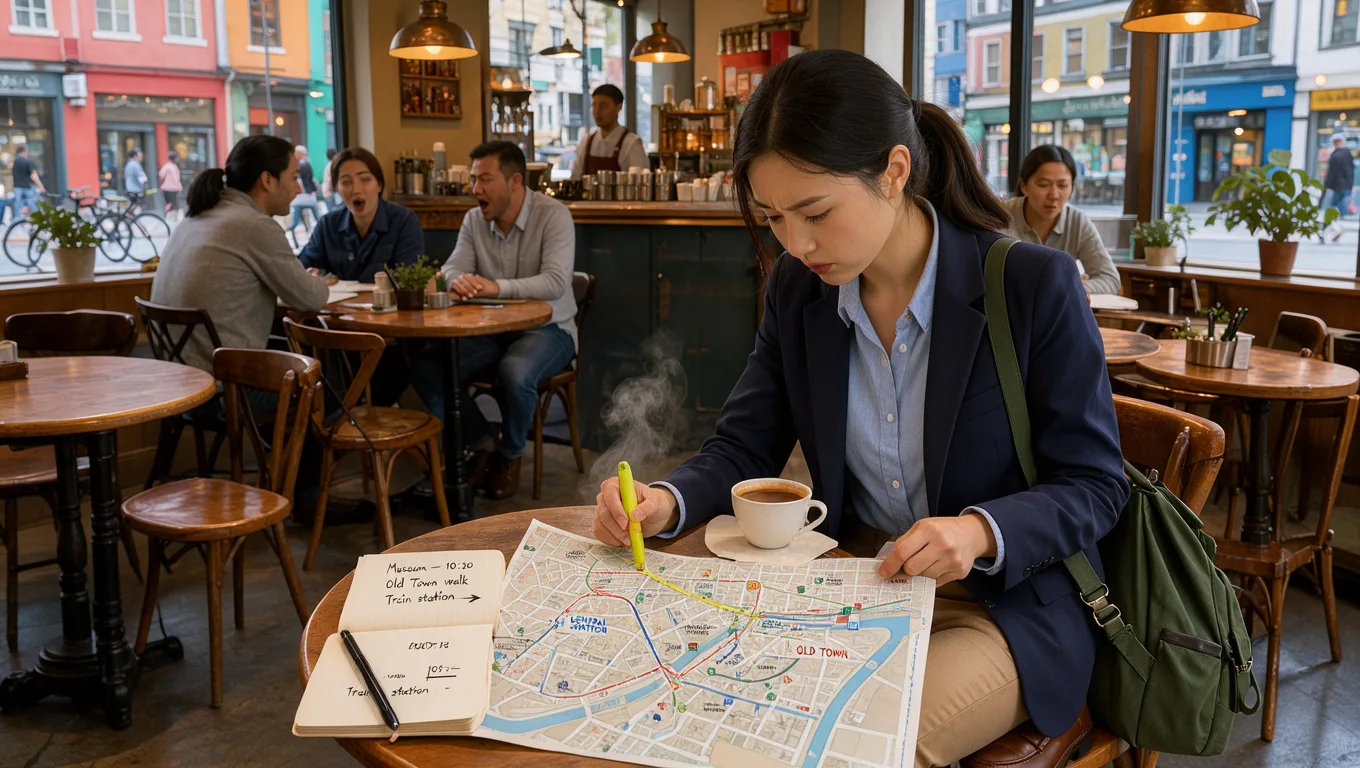
Check the route before you set out, including where you need to enter or change lines. Google Maps can give route guidance and save offline maps for areas you download in advance.
For rideshares, check the driver’s name and vehicle details in the app before getting in. Many apps show those details before pickup, and some let you share the ride with a trusted contact.
If you have an unfamiliar train or bus trip, visit the station the day before when practical. Seeing its location and services can help you find the right entrance and platform later.
Keep a backup route in mind if a train is delayed or a bus stop has moved. For an unfamiliar station, check its location and your route before the day you travel.
How can you enjoy meals and activities by yourself?
A museum visit, café lunch or walking tour can be a complete and enjoyable plan for one person. Choose activities that let you set the pace, whether you want a quiet hour or a full day out.
For a meal, try a quieter restaurant, sit at a counter or café bar, or bring a book or journal. A meal does not need to be a social event to feel like part of the experience.
Takeout can be a good choice when a dining room feels too crowded or a late drive makes going out unappealing. You can eat somewhere comfortable and save your energy for the next day.
Solo visits also let you linger where you like. At the National Gallery in London or the Victoria and Albert Museum in London, you can spend extra time with one room or take a café break.
The Musée d’Orsay in Paris is another example of a museum that can suit an independent visit. An audio guide can add context without setting the pace for you.
A walking tour, museum tour, or cooking class offers a structured activity you can join alone. A group gives you a shared focus, while you still choose how much you want to talk.
If a restaurant feels uncomfortable or too crowded, choose another place or take dinner back to your room.
How can you meet people without feeling lonely?
Worrying about loneliness is common, and a solo itinerary can include planned chances to connect. One shared activity can create company without turning the whole trip into a group trip.
Build low-pressure chances to connect
In 2026, 49% of surveyed solo travelers worried about getting lonely. Another 37% missed companionship during special moments, while 34% worried about meeting people or making friends.
Choose a social option that has a clear start and end. You can talk during the activity and then decide whether you want more company afterward.
- Join an early walking tour in a neighborhood you want to explore.
- Take a cooking class focused on local food.
- Book a small-group excursion that interests you.
- Spend time in a hostel common space or attend a local interest event.
These activities give you a shared subject for conversation. You can take part without committing every meal or day to the same group.
Make space for solitude and special moments
Some experiences may feel different without a friend beside you. A view, a celebration, or a meal can bring up the wish to share the moment.
Send a message or photo to someone at home, or write a journal entry while the details are fresh. If it feels right, invite a new acquaintance to join you for a meal or another activity.
Independent time still has value. You can notice your own reactions, change your plans, or enjoy a quiet hour without needing to fill it with conversation.
Choose one social activity that suits your interests, then keep the rest of the day open.
How do you build confidence and handle changes?
Confidence grows through manageable choices and preparation, not by pretending you have no doubts. Start with a local day trip or weekend and plan one anchor activity each day, leaving the rest of your time open.
Solo travel is also called traveling alone or independent travel. The name does not mean you must feel sure of every choice before setting out.
A manageable first solo trip gives you room to learn what works. A local outing lets you try your pace, handle small decisions, and return home without a long commitment.
Pick one main activity for each day, then leave time for rest or discoveries. A flexible schedule can make a canceled plan easier to accept, but it still needs a safe route back and a place to sleep.
If a plan falls through, pause and decide what matters most now. You can choose another activity, take a break, or change the day’s route without treating the change as failure.
Make a plan that leaves room to change, but always keep a safe way back and a place to sleep.
Be kind to yourself when something takes longer than expected. Finding a station, choosing a meal, or asking for help can take more effort in an unfamiliar place.
There is no need to prove that you can do everything alone. Asking for directions or taking a rest can be part of traveling independently.
Choose one local outing you can complete comfortably and make that your first step.
Conclusion
A memorable solo trip does not have to be far away or perfectly planned to be worthwhile. The best experience fits your interests, comfort, and the time you have.
Keep one trusted person informed, while giving yourself room to follow your own pace. You can plan carefully and still let a place surprise you.
Pick a destination, set a date for one manageable outing and take the first step.